NEET x Pioneering People in the UK: Understanding Young People’s Skills Beyond Employment Status
Nearly one million young people in the UK are currently not in education, employ


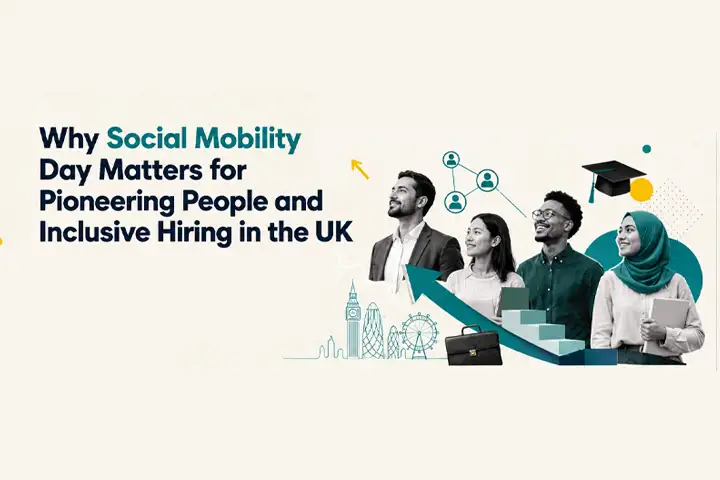
Millions of people across the UK go to work every single day knowing they will earn less than the person sitting next to them not because of their output, their skills, or their commitment, but because of the family they were born into.
That injustice is exactly what Social Mobility Day was created to confront.
This year, Social Mobility Day falls on Thursday 11 June 2026, under the theme #StoriesMatter. It is the most powerful theme the movement has chosen yet because it recognises something important: data alone does not change minds. It is the real, lived stories of people who broke through barriers, and the employers who helped them get there, that shift culture and drive action.
At Pioneering People, we understand this personally. Our platform was built for people who deserve a fair shot at work above living wage, verified employers, and same day pay. Social mobility is not an abstract concept for us. It is the reason we exist.
Social Mobility Day is an annual UK awareness event held on the second Thursday of June. First launched in 2022, it exists because social mobility in Britain is, by international standards, genuinely poor.
Social mobility refers to the ability of an individual to move up or down in society relative to the circumstances they were born into. The UK consistently ranks near the bottom of developed-world league tables for intergenerational mobility. A child born into poverty in Britain has far less chance of escaping that poverty as an adult than their peers in Denmark, Germany, or Canada.
The day brings together workers, employers, charities, and policymakers with one shared aim: to make talent not background the deciding factor in where you end up.
In 2026, the #StoriesMatter theme asks all of us individuals and organisations alike to share the moments that changed paths, challenged perceptions, and proved that where you start does not have to define where you finish.
It is easy to talk about social mobility in vague terms. The statistics make the reality impossible to ignore.
30% of children in the UK are living in relative poverty after housing costs, according to the Social Mobility Commission's State of the Nation 2024 report. Poverty in childhood directly limits educational attainment, career aspiration, and long-term earning potential.
39% of the UK workforce comes from a lower socioeconomic background than the combined population of London, Manchester, and Leeds. Yet this group remains significantly underrepresented at senior and professional levels.
The class pay gap stands at 12%. The Social Mobility Foundation found that working-class professionals earn an average of £6,287 less per year than colleagues from professional-managerial backgrounds in identical roles. In the private sector, that gap widens to £7,774 annually.
Put simply: working-class professionals in the UK are effectively working for free for around six weeks every year, compared to their more privileged counterparts.
Regional inequality deepens the problem further. Young people in London and the South East continue to enjoy the best social mobility outcomes. The Social Mobility Commission's State of the Nation report confirmed that people in the North East, former mining towns, and coastal communities face the most entrenched disadvantages with very little sign of the gap closing.
Previous Social Mobility Day themes #ShiftMindsets in 2025, #SpeakMore in 2023 built momentum. But #StoriesMatter goes a step further.
Stories do something that statistics cannot. They make the abstract personal. They allow someone from a similar background to see themselves in the narrative and believe that progress is possible for them too. And they hold up a mirror to the organisations whose cultures and hiring practices either open doors or quietly keep them shut.
The #StoriesMatter theme challenges every individual and employer to go public to share the moment a door was opened, the colleague who became a mentor, the application that almost did not happen, the shift that changed everything.
For workers, sharing your story is an act of visibility. It tells the next generation: the class ceiling is real, but it can be broken.
For employers, sharing your story is accountability. It is evidence that your diversity commitments go beyond a slide in an all-hands presentation.
This is how culture changes not through policy alone, but through the accumulation of real experiences that make inclusion feel normal rather than exceptional.
Social Mobility Day has prompted a measurable shift in how UK employers think about inclusive recruitment. Over 400 organisations have now entered the Social Mobility Employer Index. But most businesses, especially smaller ones, are still at the starting line.
Here is what the best employers are doing differently.
Dropping blanket degree requirements. Law firm Browne Jacobson removed minimum academic grade requirements in 2016. By 2025, 65% of their training contract offers were going to non-Russell Group graduates, up from just 10% before the change. The talent was there all along. The filter was the problem.
Moving to skills-based hiring. Structured assessments, work samples, and standardised scoring reduce the influence of school name, accent, and social confidence. They make hiring decisions based on capability rather than perceived "fit".
Creating paid entry pathways. Apprenticeships, traineeships, and paid internships replace unpaid work experience which only works for candidates who can afford to work for nothing. Access to opportunity should not be a financial privilege.
Measuring socioeconomic background data. Of organisations in the 2024 Social Mobility Employer Index, 26 already measure their class pay gap, including PwC and Co-op. Anonymous voluntary surveys asking standardised questions like parental occupation at age 14 give employers the evidence they need to act rather than assume.
Supporting progression, not just entry. Reaching a professional role is only the beginning. Mentoring programmes, transparent promotion criteria, and socioeconomic background employee resource groups help ensure working-class talent advances not just arrives.
Social Mobility Day 2026 arrives at a critical legal moment for UK employers. The regulatory landscape around socioeconomic diversity and inclusive hiring is shifting fast.
The socioeconomic duty Section 1 of the Equality Act 2010 has been dormant in England for over a decade, despite being active in Scotland since 2018 and Wales since 2021. Labour's 2024 manifesto committed to finally implementing it in England. When activated, it will require public bodies and large employers to actively consider how their decisions reduce socioeconomic disadvantage.
The Employment Rights Act 2025 introduces mandatory equality action plans for organisations with 250 or more employees. Voluntary publication opened in April 2026 meaning right now, employers can and should be submitting plans ahead of the mandatory deadline expected in spring 2027.
These plans must demonstrate what employers are doing to address pay gaps and promote workplace fairness. Government guidance explicitly identifies socioeconomic background as a relevant factor within those plans.
The message is clear: socioeconomic diversity is moving from a voluntary commitment to a legal expectation. Employers who begin measuring, reporting, and acting now will be ahead of the curve not scrambling to catch up.
Social Mobility Day is 24 hours of awareness. The barriers it highlights exist 365 days a year.
That is the gap Pioneering People was built to close.
Our platform connects workers Pioneers with verified UK businesses Destinations for temporary shifts that pay at or above the National Living Wage. Every employer on the platform is verified through Companies House. Every Pioneer gets paid the same day their shift ends.
No waiting weeks for a payslip. No unpaid "trial shifts." No hidden fees. Just verified work, fair pay, on time.
For many of our Pioneers, flexible gig work is not a fallback plan. It is a lifeline and a launchpad. It closes income gaps while someone retrains. It gives working parents the ability to earn around childcare. It lets people from lower socioeconomic backgrounds enter the labour market on their terms without needing a degree, a connection, or a guarantee from a recruitment agency.
Widening access to employment is not something we put in a mission statement. It is what the product does every day.
If you are a worker looking for flexible, fairly paid shifts, sign up as a Pioneer here.
Social Mobility Day 2026 is a moment to act, not just to acknowledge. Here are concrete steps for everyone.
If you are an employer:
Audit job descriptions and strip out degree requirements that are not genuinely necessary
Run an anonymous workforce survey to understand the socioeconomic background of your team
Enter the Social Mobility Employer Index to benchmark where you stand
Launch at least one paid entry pathway apprenticeship, traineeship, or paid internship this year
Post a #StoriesMatter story from your organisation today
If you are a recruiter:
Review screening criteria for unintentional class bias
Advertise roles beyond traditional graduate platforms
Introduce structured scoring to remove subjectivity from interview decisions
If you are a worker:
Share your story #StoriesMatter because your experience is evidence that change is possible
Know the class pay gap is real, document your value, and negotiate accordingly
Explore flexible work options through platforms like Pioneering People that give you income and autonomy without gatekeeping
Social Mobility Day 2026 is a reminder that the UK still has a long way to go.
The class pay gap is real. The geographic inequality is real. The hiring bias however unintentional is real. And 30% of children growing up in relative poverty right now will face the consequences of that for decades.
But so is the progress. More employers are measuring socioeconomic background. More organisations are removing arbitrary barriers. More platforms are making fair, accessible work possible for people who the traditional job market too often overlooks.
This year, the message is simple: your story matters. Tell it. And if you are an employer, create the conditions where more stories like it become possible.
Social Mobility Day 2026 falls on Thursday 11 June 2026. It is held annually on the second Thursday of June and was first launched in the UK in 2022
The theme for Social Mobility Day 2026 is #StoriesMatter. It calls on individuals and organisations to share real, lived experiences of breaking through social barriers because personal stories shift culture in ways that statistics alone cannot.
Social mobility refers to a person's ability to move up or down in society relative to the circumstances they were born into. It matters in the UK because the country consistently ranks near the bottom of developed-world league tables for intergenerational mobility meaning your postcode, your parents' occupation, and your school still have a significant influence on how far you go in life.
The class pay gap is the difference in earnings between people from working-class backgrounds and those from professional-managerial backgrounds doing the same job. Research by the Social Mobility Foundation found this gap stands at 12% around £6,287 less per year for working-class professionals.
Nearly one million young people in the UK are currently not in education, employ

Every year, something strange happens across the UK in early September. The nigh
September often feels like a second January. The summer rush starts to fade, rou