Temporary Jobs with No Experience in the UK: How to Get Your First Shift
When your first job seems overwhelming, and all the jobs are looking for experie
August, 27, 2026

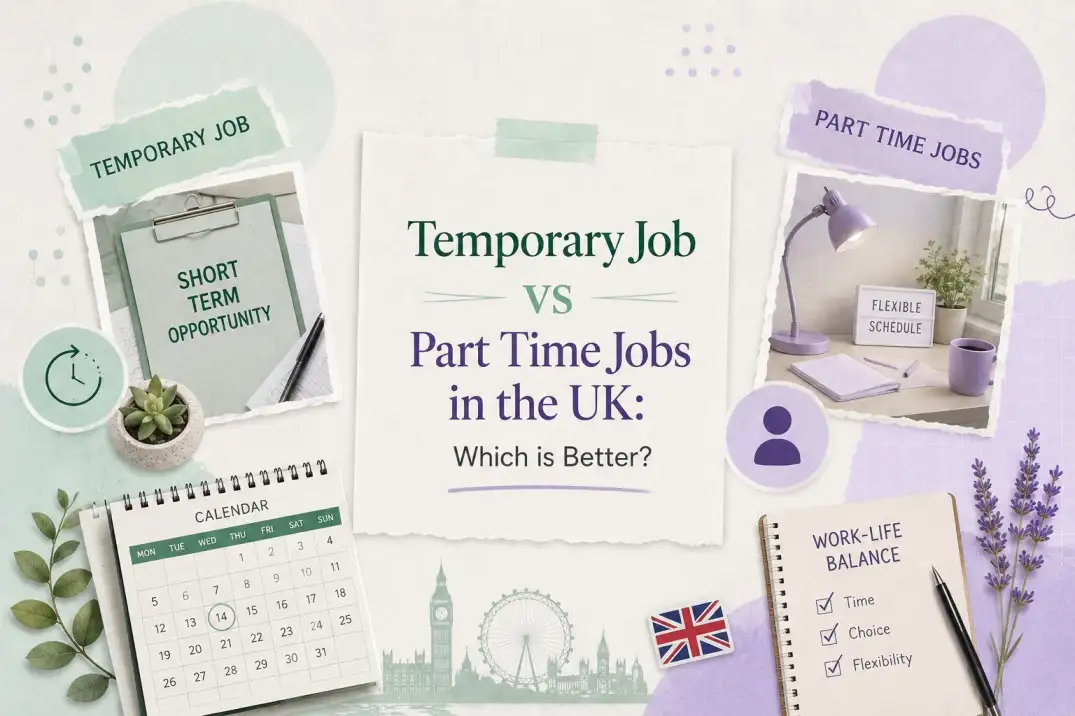
Choosing between temporary jobs vs part time jobs in the UK can feel confusing, especially when both seem to offer similar flexibility on the surface. But these two employment types work very differently, and picking the wrong one for your situation could cost you time, income, and career progress.
Whether you're a student, a parent returning to work, someone between permanent roles, or simply looking for a better work-life balance, understanding what each option actually offers in 2026 is essential. The UK job market has evolved significantly, and so have your rights and opportunities within it.
In this guide, we break down exactly what sets temporary and part-time jobs apart, what each one offers, and how to decide which is the smarter move for where you are right now.
This is the question most job seekers get wrong. The key thing to understand is that temporary jobs define how long you work, while part time jobs define how many hours you work each week. They are not the same thing, and they are not mutually exclusive either.
You can be in a temporary part-time role (short-term, fewer hours) or a permanent part-time role (ongoing, fewer hours). Similarly, a temporary job can be full-time hours for a fixed period. Once you grasp this distinction, everything else becomes much clearer.
Here's a quick breakdown:
A temporary job in the UK is a role with a defined start and end date. This can range from a single day to several months, sometimes longer if it's a fixed-term contract for a specific project, to cover maternity leave, or to manage seasonal demand.
Temporary workers in the UK are often placed through recruitment or staffing agencies, though some employers hire directly. After 12 weeks in the same role, temporary workers placed via agencies gain equal treatment rights under the Agency Workers Regulations 2010, including the same basic pay and working conditions as permanent employees in equivalent roles.
Seasonal roles in retail and hospitality (Christmas, summer)
Cover for maternity, paternity, or long-term sick leave
Project-based contracts in construction, IT, and marketing
Short-term admin or support roles in public sector organisations
Temporary jobs in the UK are widely available across sectors. In 2026, roles in healthcare, logistics, education, and warehousing continue to see strong temporary demand.
A part time job in the UK means working fewer hours than a standard full-time position, typically under 35 hours per week. However, there is no fixed legal minimum that defines "part-time" hours. Some part-time workers do 10 hours a week; others do 30 hours.
What makes part-time employment distinct is that it is generally permanent. You are a contracted employee of the organisation, protected under the Part-Time Workers (Prevention of Less Favourable Treatment) Regulations 2000. This means you are entitled to the same pay rates, holiday entitlement, pension contributions, and access to training as full-time colleagues, calculated on a pro-rata basis.
Parents managing childcare responsibilities
Students balancing study and income
Carers looking after a family member
People phasing into or out of retirement
Professionals running their own business or freelancing alongside
Flexible part-time jobs have grown significantly in the UK since 2020, with many employers now offering hybrid or remote part-time contracts across sectors like marketing, admin, customer service, and education.
Temporary work gives you one of the biggest benefits of all: control. You decide which assignments to take, when to be available, and how long to stay in a role. If you have other commitments, whether personal projects, travel, or studies, temporary work lets you fit employment around your life rather than the other way around.
Not sure which career path is right for you? Temporary roles let you test different sectors without long-term commitment. You might try logistics one month and office administration the next. This kind of exposure can be invaluable when you are still figuring out where you want to build your career.
Extended gaps on a CV can raise questions for employers. Taking on temporary work during a job search or career transition keeps your employment history continuous and demonstrates that you are proactive, adaptable, and still developing professionally.
Many UK employers use temporary roles as a trial period. If you perform well and fit the team, there is often a genuine opportunity to convert your temporary position into a permanent one. It is a low-risk way for both you and the employer to assess the fit before making a longer commitment.
Because temporary workers often miss out on benefits like sick pay and pension contributions from the employer, the hourly rate tends to be higher to compensate. In sectors like healthcare, manufacturing, and specialist IT, temporary day rates can significantly exceed what a permanent employee earns per hour.
The most obvious downside: when the contract ends, your income stops. You are responsible for finding the next assignment, which can create financial uncertainty — especially during quieter hiring periods.
Unless you have completed 12 qualifying weeks in the same role, you may not receive the same workplace benefits as permanent staff. Sick pay, holiday pay, and pension enrolment may be limited or absent, depending on your contract type and whether you are paid via a recruitment agency.
When you are moving between roles and employers, building deep professional relationships takes more effort. If teamwork and workplace community matter to you, temporary work can sometimes feel isolating.
Part-time work gives you the best of both worlds in many situations: the security of a permanent employment contract with the freedom of fewer hours. You have a consistent income, a set schedule, and the same employment rights as full-time colleagues.
Under UK employment law, part-time employees are protected from day one. You cannot be treated less favourably than a comparable full-time worker. Your holiday pay, pension auto-enrolment, and access to training must be provided on a pro-rata basis.
Whether that is caring for children, studying for qualifications, pursuing a side business, or simply maintaining your wellbeing, part-time work creates the space you need without sacrificing a regular income entirely.
Unlike temporary roles, part-time jobs are permanent positions within an organisation. That means you can build relationships, develop your skills over time, take on more responsibility, and move up all while working fewer hours than a full-time colleague.
With a set number of hours and a consistent wage, part-time employment is far easier to budget around than the variable income that often comes with temporary work. If financial predictability matters to you, part-time wins.
Fewer hours means a smaller pay packet overall, even if the hourly rate is the same as full-time. If you are the primary earner in your household, part-time income may not stretch far enough without additional income sources.
While part-time jobs offer schedule consistency, they typically do not offer the same degree of freedom to take extended breaks, change sectors rapidly, or choose when you work. Your schedule is largely set by your employer.
In some industries and organisations, part-time workers can be unfairly seen as less committed than full-time staff. This can affect how performance reviews are handled and whether certain development opportunities come your way.
There is no single right answer here it genuinely depends on your personal circumstances, financial situation, and career goals. Here is a practical way to think about it:
You want maximum flexibility and the ability to take extended breaks
You are exploring different industries or building a diverse CV
You need income quickly and do not want to wait for a long hiring process
You are comfortable with income variability and uncertainty between contracts
You want to test a company or industry before committing to a permanent role
You want employment stability with a permanent contract
You need consistent, predictable income to manage household finances
Work-life balance is your priority alongside job security
You want to grow within a single organisation over time
You need access to full UK employment rights from day one
Yes, and many UK workers are doing so. The lines between temporary and part-time work have blurred considerably in 2026. Many employers now offer flexible part-time jobs that combine elements of both: permanent contracts with variable hours, or rolling short-term contracts that convert based on performance.
Remote and hybrid part-time roles have expanded across sectors including fintech, marketing, education, and customer experience. Meanwhile, gig platforms and staffing apps have made finding temporary work in the UK faster and more accessible than ever, particularly in London, Manchester, Birmingham, and other major cities.
If you are registered with a good staffing partner or recruitment agency, you may find that temporary assignments naturally lead to flexible part-time offers giving you the ideal blend of exposure, flexibility, and eventual stability.
If career exploration, maximum flexibility, and quick entry into work are your priorities, temporary jobs in the UK are the stronger choice right now. The 2026 UK job market continues to see high demand for temporary workers across logistics, healthcare, education, and hospitality.
If you value job security, consistent income, and long-term career development within a single organisation, part-time jobs in the UK are the smarter option, especially with the strong legal protections available to part-time employees.
The best-case scenario? Use temporary work to explore and build your CV, then convert that experience into a permanent part-time role that fits your lifestyle. Many of the best opportunities start as one and become the other.
At Pioneering People, we work with candidates across both employment types to match them with roles that align with their goals, whether that is a temporary assignment that opens doors or a flexible part-time position that gives them room to thrive. Browse our temporary job platform and take the next step in your career today.
Part-time defines how many hours you work, fewer than a full-time employee, usually under 35 hours per week, on an ongoing permanent contract. Temporary defines how long you work, a fixed period or project with a set end date. A temporary role can be full-time or part-time in hours.
After 12 continuous weeks in the same role with the same employer, agency temporary workers are entitled to the same basic pay and working conditions as comparable permanent staff under the Agency Workers Regulations 2010. This is commonly called the 12-week or 3-month qualifying rule.
The main downsides of temporary jobs include:
No guaranteed income between contracts
Limited access to sick pay, pension, and workplace benefits before 12 qualifying weeks
No long-term job security; contracts can end with little notice
Harder to build lasting workplace relationships
Can make mortgage or credit applications more difficult
Once a temporary worker has been continuously employed by the same employer for two years, they gain the legal right to protection against unfair dismissal under the Employment Rights Act 1996. Separately, fixed-term employees employed for four or more consecutive years automatically become permanent employees under UK law.
Yes. Many UK employers use temporary roles as a trial period. If you perform well and a need continues, they can offer a permanent contract often part-time or flexible. Roles advertised as temp-to-perm are specifically designed with this conversion in mind from the start.

When your first job seems overwhelming, and all the jobs are looking for experie
August, 27, 2026
Ever scrolled past a "Temporary Retail Assistant Needed" post and wondered if it
August, 27, 2026
Temporary staffing is a challenge for UK businesses, especially during busy seas
August, 27, 2026